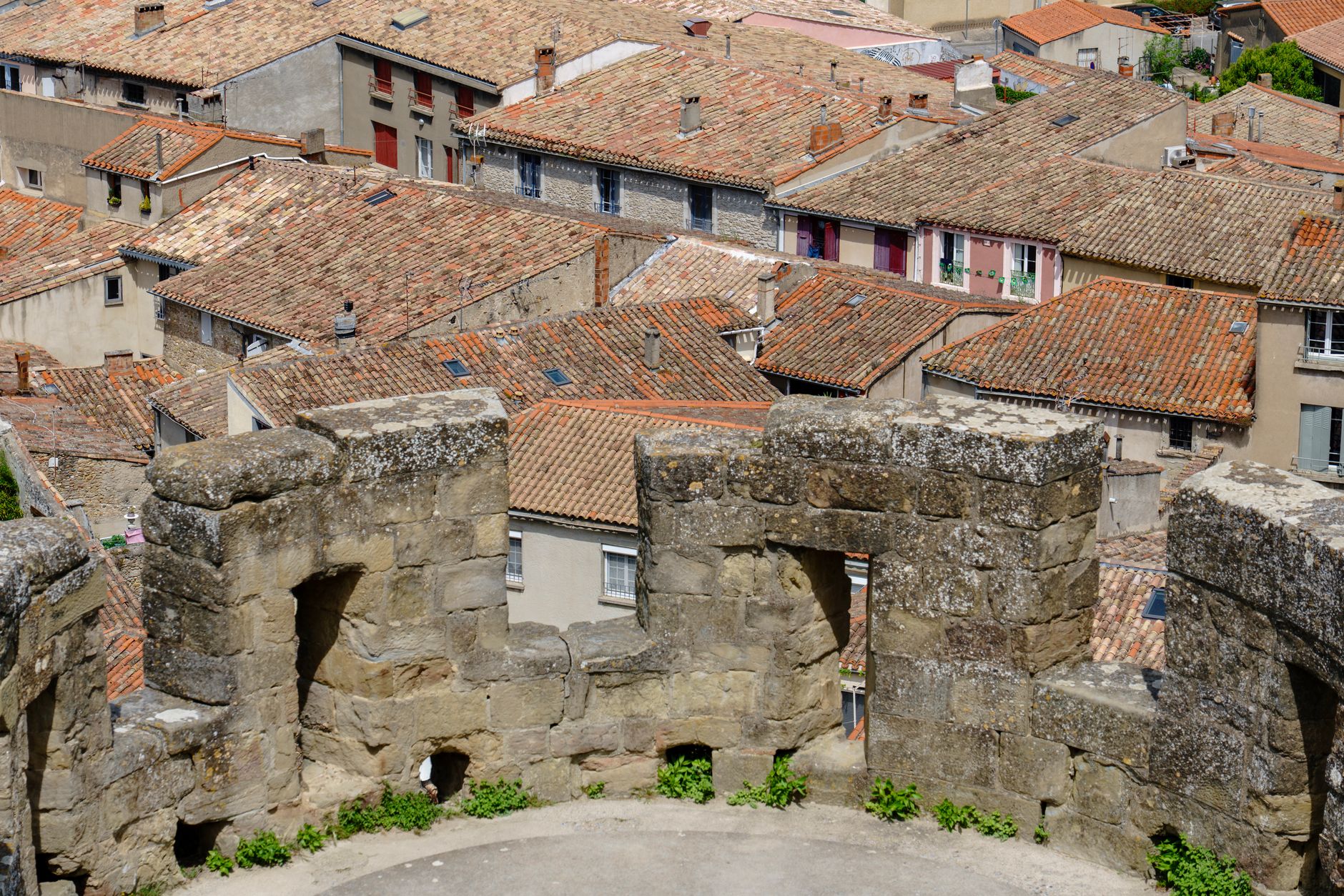
From a distance, the walled city of Carcassonne looks almost too good to be true: a bristling silhouette of towers and ramparts rising above the vineyards of the Languedoc, intact and imperious against the southern French sky. That instinct — that it looks too perfect — turns out to be worth following. Carcassonne's medieval citadel is one of Europe's most layered historical sites, where genuine Roman stonework, Visigothic masonry, and medieval fortifications sit alongside the confidently imagined reconstructions of the 19th century's most influential restorer. Understanding which is which doesn't diminish the place. It makes it twice as interesting.
A Fortress Built Over Millennia
The hill on which Carcassonne stands has been fortified for more than two thousand years. The Romans established a presence here, and sections of the inner wall still incorporate Roman-era stonework — recognizable to a trained eye by the distinctive courses of brick interspersed with stone, a Roman construction technique called opus mixtum. After Roman power receded, the Visigoths held and expanded the fortifications, and their contributions survive in portions of the inner ramparts and several of the towers.
The medieval period layered yet more onto this foundation. During the 12th and 13th centuries, Carcassonne was a stronghold of the Trencavel viscounts, a dynasty closely entangled with the Cathar heresy that was sweeping the Languedoc. When the Crusade against the Cathars — the Albigensian Crusade — swept through the region in the early 13th century, Carcassonne fell to Simon de Montfort in 1209, and the city eventually passed into the hands of the French crown. The kings of France, recognizing its strategic importance on the border with Aragon, substantially rebuilt and strengthened it throughout the 13th century, adding the outer ring of walls and transforming the citadel into the concentric double-walled fortress whose outline we see today.

As an Amazon Associate, I earn from qualifying purchases.
That outer wall, with its distinctive towers, is largely Capetian — the work of Louis IX (Saint Louis) and his son Philip III. The gap between the inner and outer walls, called the lices, is a deliberate defensive feature: any attacker who breached the outer wall would find themselves trapped in a killing ground with no cover. It's sophisticated military engineering, and it is genuinely medieval.
💼 Career Opportunities
The Long Decline — and Near Demolition
Here is the part the tourist brochures tend to skip. By the early 19th century, Carcassonne's citadel was in a sorry state. After the Treaty of the Pyrenees in 1659 moved the French-Spanish border southward, the fortress lost its strategic purpose almost overnight. The population gradually migrated down to the lower town, the bastide, and the upper city slowly fell apart. Buildings were cannibalized for stone; towers were abandoned; sections of wall crumbled.
The French government at one point seriously considered demolishing what remained and selling off the stone. Local protests and the intervention of the writer and historian Prosper Mérimée — who served as Inspector General of Historic Monuments — helped delay this fate. Mérimée commissioned a report and eventually secured state protection for the site. What was needed next was someone to actually rebuild it.
Enter Viollet-le-Duc
Eugène Emmanuel Viollet-le-Duc was the most celebrated architectural restorer in 19th-century France, and arguably in all of Europe. He had already made his name restoring the Sainte-Chapelle and Notre-Dame de Paris when, in 1853, he was appointed to lead the restoration of Carcassonne. He would work on the project — with his successor Paul Abadie carrying it forward after his death — for decades.
As an Amazon Associate, we earn from qualifying purchases.
Viollet-le-Duc was not, by his own philosophy, trying simply to preserve what existed. His famous definition of restoration — that it meant returning a building to a complete state that may never have existed at any given moment — tells you everything you need to know about his approach. He was reconstructing an ideal medieval fortress, synthesizing evidence from the actual remains, from historical documents, and from his own formidable knowledge of medieval architecture. Where evidence was absent, he made educated — and sometimes not-so-educated — decisions.
What He Got Right
Much of what Viollet-le-Duc did at Carcassonne was genuinely scholarly. He consolidated and repaired walls that were structurally sound but deteriorating. He restored towers using the original stones where they could be found and documented. He drew extensively on surviving medieval manuscripts and his own archaeological investigations of the site. The overall layout — the double ring of walls, the positions of the towers, the Château Comtal at the heart of the inner city — reflects authentic medieval design, even where the specific stones are not original.
His restoration of the Château Comtal, the inner castle of the Trencavel viscounts, is considered among his more reliable work, hewing closely to what the evidence supported. The Basilica of Saint-Nazaire inside the walls is another case where Viollet-le-Duc worked carefully, preserving remarkable original Gothic and Romanesque stonework including some extraordinary medieval stained glass.
What He Got Wrong — or Simply Invented
The most famous controversy surrounds the roofs of Carcassonne's towers. Viollet-le-Duc topped them with steep, pointed, slate-covered conical caps — the silhouette that makes the city look like every childhood idea of a fairy-tale castle. His critics, then and since, have argued that in southern France, medieval towers were almost certainly roofed with flat or low-pitched terracotta tile, not the steep slate cones more typical of northern French architecture. Viollet-le-Duc knew the northern tradition best, and it shows.
He essentially imposed a northern French aesthetic on a southern French fortress. The conical slate roofs are architecturally convincing — even beautiful — but they are probably not what stood here in the 13th century. They are, in a meaningful sense, his invention. When you photograph those famous towers against a Languedoc sunset, you are photographing Viollet-le-Duc's imagination as much as the Middle Ages.
Beyond the rooflines, there are towers that were essentially rebuilt from near-ground level, internal structures that are 19th-century constructions informed by medieval precedent rather than surviving medieval fabric, and decorative details that reflect his synthesis of what a great medieval fortress ought to look like. The restoration is not a fraud — it is a scholarly intervention of its time — but it is an intervention, and a confident one.
How to Read the Walls as You Walk Them
A visitor who knows what to look for can do a kind of visual archaeology as they walk the lices between the two rings of walls. The inner wall is older and shows more variation in its stonework — rough, irregular courses, different colors and textures of stone, occasional Roman-era brick courses. This heterogeneity is the signature of real age and multiple building campaigns.
The outer wall and many of its towers are more uniform, more neatly finished: a sign of 19th-century reconstruction. Where you see crisp, even ashlar masonry with consistent tooling, you are often looking at Viollet-le-Duc's work. Where the stone is irregular, worn, and varied, you may be touching something genuinely medieval. The towers labeled on site plans with dates help: those identified as Gallo-Roman or Visigothic preserve the most ancient fabric, while the outer Capetian towers are a mix of surviving medieval core and 19th-century completion.
The Basilica of Saint-Nazaire is essential for understanding what survived without heavy intervention. Its Romanesque nave dates from the 11th and 12th centuries; its Gothic transepts and choir are 13th and 14th century. The medieval stained glass in the rose windows is among the finest surviving in southern France. Here, the original fabric dominates, and the atmosphere is genuinely that of a medieval religious space.
The UNESCO Inscription and Its Implications
Carcassonne was inscribed as a UNESCO World Heritage Site in 1997. The inscription acknowledges the site as an outstanding example of a medieval fortified town — and implicitly accepts that Viollet-le-Duc's restoration is now part of the site's historical significance in its own right. The restored citadel is itself more than 150 years old. The 19th-century reconstruction has become history.
This is the deepest irony of Carcassonne: the controversy over what is authentic has slowly resolved itself through time. Viollet-le-Duc's additions are no longer modern interventions. They are an older layer in the site's story — the layer that ensured all the genuinely ancient layers beneath survived at all.
Why the Debate About Restoration Still Matters
Viollet-le-Duc's approach to Carcassonne was enormously influential on how European nations thought about restoring historic sites through the late 19th and early 20th centuries. It generated a significant backlash, notably from the English critic John Ruskin, who argued that authentic age and patina could not and should not be reconstructed — that to do so was to destroy the very thing you were trying to preserve. This debate eventually contributed to the modern conservation philosophy encoded in documents like the Venice Charter of 1964, which emphasizes minimal intervention and the clear distinction between original fabric and new additions.
Walking Carcassonne is, among other things, a walk through that argument made physical. The site demonstrates both what is gained by ambitious restoration — an accessible, comprehensible, and genuinely magnificent medieval fortress that might otherwise be a field of rubble — and what is lost or obscured when restoration crosses into reinvention.
For travelers interested in the deeper history of medieval conflict in the Languedoc, Carcassonne connects to a whole landscape of forgotten battlefields and fortified sites that shaped the political and religious geography of southern France.
What to Actually Do With This Knowledge
None of this should discourage a visit — it should sharpen one. A few practical suggestions for getting more from the citadel:
Take the rampart walk
The walk along the outer walls and through the lices is free and gives you direct access to the stonework. Look at it closely. Touch it where you can. The tactile difference between weathered medieval stone and smoother 19th-century repair is real and legible.
Visit the Château Comtal separately
The inner castle requires a ticket and includes a guided circuit of the ramparts with interpretation. The guides at this site are generally knowledgeable about what is original and what was restored — ask directly, and most will tell you.
Spend time in Saint-Nazaire
The basilica is the least-restored major structure inside the walls and the best place to encounter the medieval city on its own terms. Go when the light comes through the old glass.
Come early or late
Carcassonne receives millions of visitors per year, and the interior of the cité can feel overwhelming at peak hours. The citadel at dusk or early morning, when the tour groups have thinned, is a different experience entirely — and the light on those controversial slate roofs is genuinely beautiful, whatever their historical accuracy.
Carcassonne is, in the end, a place where several different kinds of truth coexist: the truth of what medieval builders constructed over centuries, the truth of what one determined 19th-century architect believed a fortress should look like, and the truth that without him, there might be nothing here to argue about at all. The citadel rewards visitors who hold all three in mind at once — and it's a far more interesting place for the complexity.