Most travelers arrive in Tirana, Kotor, or Ljubljana with a vague sense that history happened here — wars, empires, upheaval — but without the vocabulary to decode what they're actually looking at. The result is a frustrating kind of tourism: beautiful things seen without being understood. That's a shame, because the built environments of Albania, Montenegro, and Slovenia are among the most readable palimpsests in Europe — layers of Ottoman, Venetian, Austro-Hungarian, and mid-twentieth-century Communist construction literally stacked on top of one another, each layer telling you who held power, who was being taxed, who was being converted, and who was being watched.
This guide is a primer on reading those layers. You don't need an architecture degree. You need a framework.
Why These Three Countries, and Why Now
Western European hubs — Rome, Prague, Dubrovnik — have become so saturated that the experience of visiting them is increasingly managed, monetized, and mediated. Travelers with genuine curiosity are looking elsewhere. Albania, Montenegro, and Slovenia offer something increasingly rare: the same depth of European history with far fewer people standing between you and the actual fabric of the place. These are also countries where the architecture hasn't been uniformly restored into a theme-park version of itself. The friction — the crumbling minaret next to the socialist-era apartment block next to the Baroque church — is still visible. That friction is the story.

As an Amazon Associate, I earn from qualifying purchases.
The Ottoman Layer: Reading What Remains
The Ottoman Empire held significant portions of the western Balkans for roughly four to five centuries, and it did not build lightly. But Ottoman architecture in this region is frequently misread by visitors accustomed to the grand mosque complexes of Istanbul or Cairo. Here, Ottoman building was often more intimate, more adaptive, and more syncretic.
💼 Career Opportunities
What to Look For in Albania
Albania spent the longest time under direct Ottoman administration of the three countries discussed here, and it shows. The key architectural markers are the han (roadside inn), the çarshi (covered bazaar district), the tekke (Bektashi Sufi lodge), and the kulla — the fortified stone tower-house that is uniquely Albanian and predates Ottoman rule but was adapted and formalized during it.
The kulla deserves special attention because it's often dismissed as a defensive structure and nothing more. In fact, the internal organization of a kulla — the separation of the guest room (oda) from the family quarters, the placement of the hearth, the narrow windows designed for light management as much as defense — encodes an entire social system. The Albanian kanun, the customary law that governed highland communities, is physically expressed in kulla architecture. When you stand in one, you are standing inside a legal document.
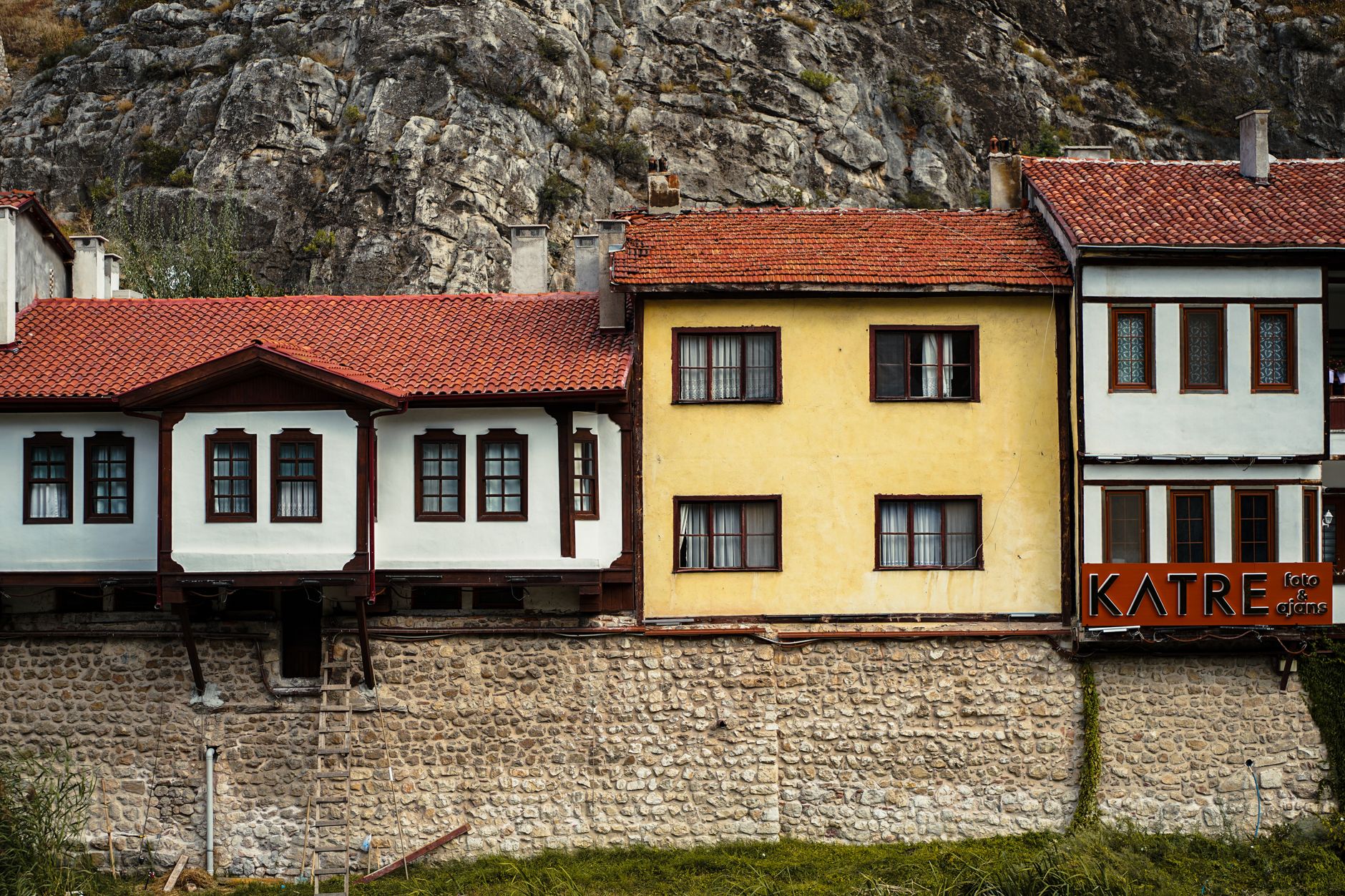
Berat, Albania, known as the 'City of a Thousand Windows,' contains an inhabited medieval castle district (kala) continuously occupied since antiquity and is a UNESCO World Heritage Site designated in 2008. The kala of Berat is one of the best places in the region to see Ottoman domestic architecture in its actual context — not reconstructed, not museumified, but lived in. The characteristic Ottoman house here features overhanging upper floors (a technique that maximized floor space while keeping the ground-floor footprint small, reducing land tax in some Ottoman administrative systems), large banks of windows facing inward to a courtyard or outward over a view, and an insistence on natural light that contradicts the Western stereotype of Islamic domestic architecture as closed and inward-facing.
As an Amazon Associate, we earn from qualifying purchases.
The underrated small towns of the Albanian interior — Gjirokastra, Përmet, Voskopojë — preserve Ottoman-era streetscapes that Berat's fame has made easy to overlook. Gjirokastra in particular is a stone city of extraordinary integrity, its bazaar quarter and its fortress sitting in genuine tension across the valley.
Montenegro's Ottoman Fragments
Montenegro is interesting precisely because it was never fully subdued. The Montenegrin highlanders maintained a degree of autonomy that meant Ottoman urbanism never took the same deep root here as in Albania or Bosnia. What you find instead are frontier architectures: fortresses, watchtowers, and the kind of military infrastructure that empires build at their edges. The town of Bar, in the south, is a partial exception — its old town contains the ruins of mosques and Ottoman administrative buildings, though much was damaged in a gunpowder explosion in the nineteenth century and later by earthquake.
The more useful Ottoman reading in Montenegro is negative space: the places where Ottoman influence stopped, and why. The walled coastal towns, controlled by Venice, form a hard boundary. Cross it and the architectural vocabulary changes entirely.
The Venetian Layer: The Lion of St. Mark as Colonial Brand
The Republic of Venice was one of history's most architecturally self-conscious colonial powers. It did not merely administer its Adriatic territories — it branded them. The winged lion of St. Mark, Venice's symbol, was carved in stone above the gates of every significant town under Venetian control, and many of those carvings are still there. This was deliberate: a visual assertion of sovereignty readable by anyone, literate or not.
Kotor, Montenegro: A Venetian City in Absentia
Kotor spent nearly four centuries under Venetian rule, ending only with Napoleon's dissolution of the republic in 1797. The imprint is total. The city walls — which climb the mountain behind the old town in a way that strikes most visitors as dramatic and slightly impractical — are classic Venetian military engineering: thick enough to absorb cannon fire, angled to deflect it, studded with towers at intervals calculated to eliminate blind spots.
Inside the walls, the urban logic is Venetian: a central square (piazza) functioning as a stage for civic life, a cathedral asserting the Latin church's primacy, guild halls and noble palaces arranged in a hierarchy visible in their facades. The palaces of Kotor's nobility follow Venetian Gothic conventions — pointed arches, delicate tracery, the piano nobile elevated above a ground floor given over to commerce or storage. What makes Kotor's Venetian layer particularly legible is that so little has been built over it. The street grid, the plot sizes, the relationship between public and private space: these are all essentially sixteenth-century Venetian decisions.
Look for the Venetian wellheads — carved stone cistern covers in public squares. Venice was obsessive about fresh water management in its colonial towns, partly for public health, partly because controlling water access was controlling life. The wellheads are not decorative. They are infrastructure.
Slovenia and the Venetian Margin
Slovenia's relationship with Venice is more marginal and more interesting for it. The Republic of Venice controlled the coastal strip around Koper (called Capodistria under Venetian rule), and the architecture of Koper's old town is a compressed version of the Venetian colonial playbook: the loggia, the cathedral with its Venetian-influenced campanile, the Praetorian Palace with its layers of Gothic and Renaissance Venetian detail. Koper is also a useful reminder that Venetian architecture was not monolithic — it evolved over four centuries, and you can read that evolution in the stylistic shifts between buildings erected in the 1400s versus those from the 1600s.
Inland Slovenia, however, was largely Habsburg territory, which means a different conversation.
The Habsburg Layer: Order, Bureaucracy, and the Baroque Streetscape
The Austro-Hungarian Empire built for administration. Its architecture in Slovenia — and to a lesser extent in the Montenegrin and Albanian hinterlands where its influence reached — is characterized by a certain confident rationality: wide boulevards, uniform cornice heights, public buildings scaled to impress without being grandiose, an infrastructure of post offices, railway stations, and courthouses that expressed the empire's conviction that governance was a technical problem with engineered solutions.
Ljubljana as a Case Study
Ljubljana, Slovenia's capital, is often described as a Baroque city, which is approximately correct but misses the more interesting detail. The Baroque came first, following a devastating earthquake in 1511 that destroyed much of the medieval town and prompted a systematic rebuild. But the Ljubljana that most visitors encounter today was substantially shaped by the city architect Maks Fabiani and, more visibly, by Jože Plečnik, who worked on the city from the 1920s onward.
Plečnik is the key figure for understanding Ljubljana's built environment. A student of Otto Wagner in Vienna, he brought a highly personal synthesis of classical motifs, vernacular Slovenian forms, and modernist structural thinking to a city that became his laboratory. His Triple Bridge, his covered market along the Ljubljanica, his National and University Library — these are not Baroque, not Secessionist, not quite anything with a clean label. They are the work of someone who had absorbed the full history of European architecture and was making something new from it. Plečnik is one of the genuinely underappreciated architectural figures of the twentieth century, and Ljubljana is essentially a monograph of his work.
The Communist Layer: How to Read Socialist Architecture Without Contempt
The easiest mistake — especially for visitors from Western Europe and North America — is to dismiss Communist-era architecture as pure ugliness imposed by ideology. This is wrong in both directions. It underestimates the genuine ambitions of socialist urbanism, and it lets the architecture off the hook too easily by treating it as a cultural accident rather than a deliberate system with its own logic.
Albania's Particular Experiment
Albania under Enver Hoxha pursued one of the most extreme isolationist Communist programs in history. One of its most visible legacies is the bunker: roughly 170,000 concrete mushroom-shaped structures distributed across the entire country, from beaches to mountain passes to city parks. They were built to defend against an invasion that never came. Today they are repurposed as cafes, storage spaces, art installations, and hostels — a landscape of paranoia converted, with characteristic Albanian pragmatism, into something useful.
But the bunkers are only the most photogenic element of Hoxha's architectural program. The broader project was the construction of entirely new socialist cities — Fier, Kuçovë, Elbasan — built around industrial plants, with workers' apartment blocks, cultural houses, and party headquarters arranged according to Soviet-influenced urban planning principles. These cities are fascinating and almost entirely ignored by tourism infrastructure. They are also honest: they don't pretend to be something they're not. The cultural house in a mid-sized Albanian city is a building that tells you exactly what the state thought culture was for.
Montenegro and Yugoslavia's Third Way
Montenegro, as part of Yugoslavia rather than the Soviet bloc, experienced a different architectural trajectory. Yugoslavia under Tito pursued a policy of non-alignment, which had direct architectural consequences. Yugoslav architects had access to Western modernist ideas that were unavailable to their counterparts in Warsaw or Bucharest, and they produced a body of work — particularly in the design of war memorials, known as spomen-obilježja or spomenici — that is some of the most extraordinary monumental sculpture anywhere in the world.
These monuments, scattered across the mountains and valleys of the former Yugoslavia, were built to commemorate Partisan resistance and the fallen of the Second World War. They are brutalist, abstract, and deliberately unlike anything in the Soviet tradition. Many are now abandoned and decaying, which adds a layer of melancholy that is historically appropriate — they were built to commemorate one political order and have been neglected by the successor states. Forgotten battlefields and the monuments near them are among the most powerful architectural experiences the western Balkans offers, and almost no mainstream travel writing covers them seriously.
Reading the Layers Together: A Practical Approach
The most useful skill you can develop before visiting any of these countries is the ability to identify which empire or political system you're looking at, and then ask the right follow-up question. Not "is this beautiful?" but "what problem was this built to solve, and for whom?"
A Venetian loggia solved the problem of civic assembly and commercial display while asserting the legitimacy of Venetian rule. An Ottoman çarshi solved the problem of taxable commerce while creating a social infrastructure for a Muslim urban community. A Habsburg post office solved the problem of communications infrastructure while asserting that you were now in a modern, administered state. A Hoxha-era cultural house solved the problem of mass ideological formation while providing genuine amenities — theaters, libraries, music rooms — that many rural communities had never had before.
None of these buildings are innocent. All of them are interesting. The tension between those two facts is what makes the architecture of this region worth paying attention to.
A Few Practical Notes for the Attentive Traveler
Signage in this region is improving but still inconsistent. Many of the most significant buildings have no interpretive material at all, or material only in Albanian, Montenegrin, or Slovenian. Learning a handful of architectural terms in the local language before you go — and downloading offline maps that identify historic monuments — will significantly improve your experience. Local guides who specialize in architectural or historical tours exist in all three countries and are frequently the best investment you can make: they carry knowledge that has never been written down in English.
Finally, resist the urge to photograph everything immediately. Stand in front of a building for five minutes before you reach for your phone. Ask yourself: how old is this? Who commissioned it? What materials are local and what were imported? Who was excluded from the space it creates? The answers won't always be available, but the habit of asking them will make you a fundamentally different kind of traveler — and will make the buildings speak.
Sources
Every factual claim in this article was independently verified against the following sources:
- Berat — en.wikipedia.org