There are places on Earth where the ground beneath your feet tells a story so layered, so ancient, and so alive with human meaning that standing there feels genuinely different from standing anywhere else. Haida Gwaii — the archipelago of more than 150 islands off the northern coast of British Columbia — is one of those places. Its rocks did not originate where they now sit. Its forests survived the last Ice Age when most of Canada was buried under kilometres of ice. And the Haida people who have called these islands home for thousands of years built one of the most sophisticated maritime cultures the Pacific world has ever known. To visit Haida Gwaii is to stand at a collision point — of tectonic plates, of ocean and continent, of deep time and living culture.
A Geology That Belongs to Nowhere and Everywhere
Most of Canada west of the Rocky Mountains is underlain by the ancient, stable mass of the Canadian Shield — Precambrian rock that formed billions of years ago and has barely moved since. Haida Gwaii is something else entirely. The islands are what geologists call an allochthonous terrane, meaning the rock here did not form in place. It originated far to the south, possibly near the latitude of present-day California or even further, and was carried northward over tens of millions of years by the movement of the Pacific Plate. Haida Gwaii is, in a very literal sense, a geological immigrant — an exotic fragment that docked against the North American continent and stayed.
This origin story gives the islands their unusual character. The rocks you find here — volcanic basalts, oceanic sediments, limestones packed with ancient marine fossils — speak of a seafloor origin, not a continental one. Paleontologists have found remarkably well-preserved marine fossils in the islands' limestone formations, including Triassic and Jurassic-era specimens that hint at the warm, shallow seas these rocks once sat beneath, half a world away from where they rest today.
The Queen Charlotte Fault: Canada's San Andreas
Running along the western edge of Haida Gwaii is one of the most significant tectonic structures in North America: the Queen Charlotte Fault. Like California's famous San Andreas Fault, it is a transform fault, a place where two massive plates — the Pacific Plate and the North American Plate — grind laterally past each other. The motion here is not subtle. This fault system has generated some of the largest earthquakes ever recorded in Canada. The islands sit, quite literally, on a seismic hair-trigger.
That tectonic energy has shaped the landscape visibly. The western coastline of Graham Island, the largest in the archipelago, is rugged and battered, exposed to the full force of North Pacific swells that have crossed thousands of kilometres of open ocean. The eastern shores of Moresby Island, by contrast, face the protected waters of Hecate Strait and present a softer, more sheltered face. The islands exist in a permanent geological tension between the forces trying to pull them apart and the forests and soils doing their quiet work of covering over the scars.
💼 Career Opportunities
An Ice Age Refuge: Why Haida Gwaii Is a Biological Ark
During the last glacial maximum, roughly 20,000 years ago, a vast ice sheet covered most of Canada. The boreal forests, the prairies, the river valleys — nearly all of it was buried. But parts of Haida Gwaii appear to have escaped full glaciation, or were deglaciated early enough to serve as refugia: pockets of biological survival where species weathered the cold and later recolonised the newly exposed continent.
This refugium status helps explain the archipelago's extraordinary biodiversity and the presence of endemic subspecies found nowhere else on Earth. The Haida Gwaii black bear is larger and genetically distinct from mainland black bears. The saw-whet owl here is its own subspecies. The short-tailed weasel on these islands differs measurably from its mainland cousins. Over thousands of years of isolation, life on these islands quietly diverged, following its own evolutionary path. Biologists sometimes compare Haida Gwaii to the Galápagos Islands in terms of the evolutionary distinctiveness it has produced — a bold comparison, but one with genuine scientific basis.
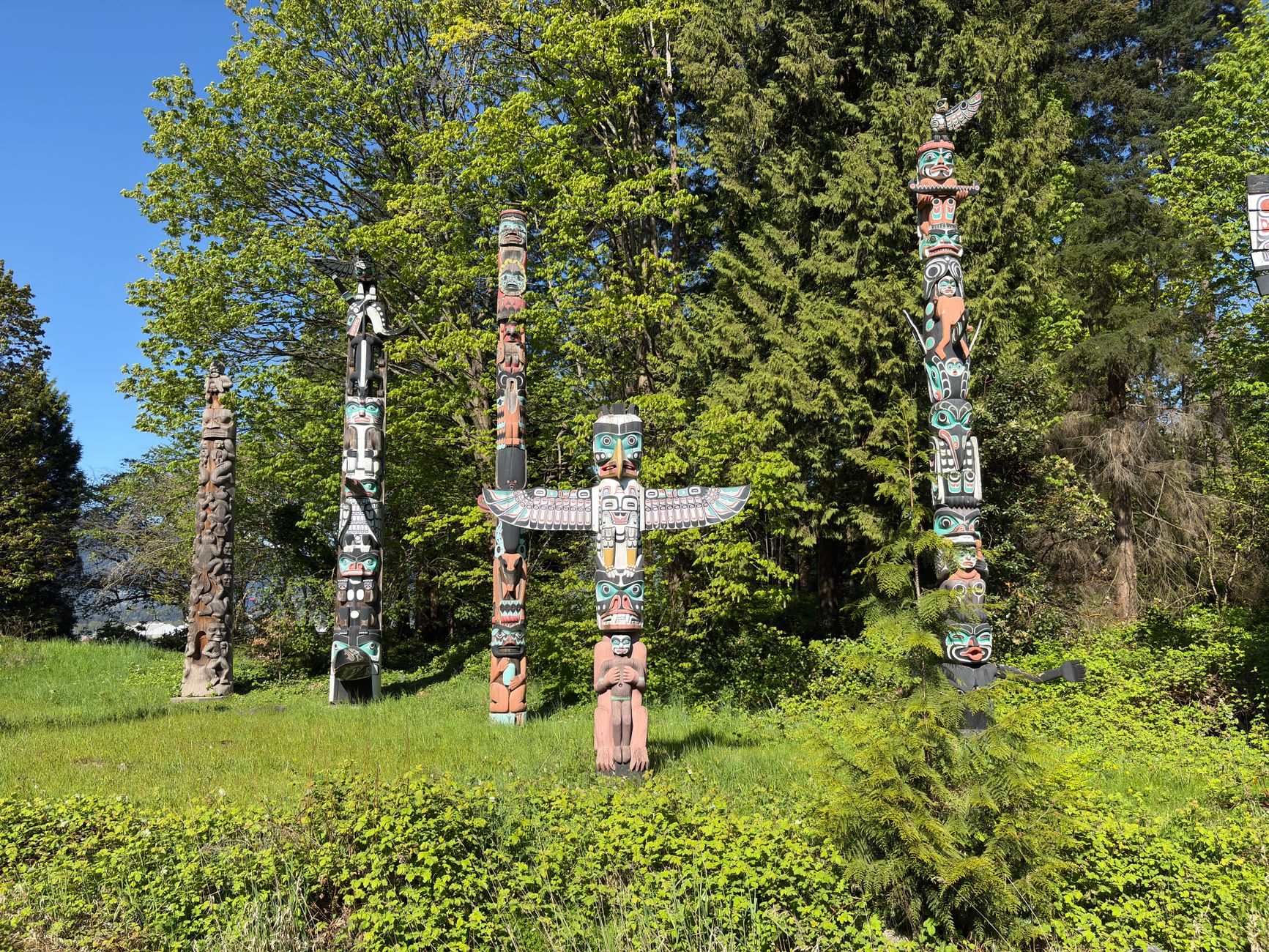
The forests themselves are staggering. Ancient Sitka spruce, western red cedar, and western hemlock grow to enormous dimensions in the wet, mild climate. Cedar in particular saturates the cultural landscape of the Haida, providing not just timber but the raw material for everything from ocean-going canoes to bentwood boxes to towering totem poles.
The Haida: A Maritime Civilisation at the Edge of the World
To speak of Haida Gwaii's geology and ecology without speaking at length about the Haida people would be to miss the point entirely. The Haida have inhabited these islands for at least 12,000 to 13,000 years, with some researchers suggesting an even deeper occupation made possible by those ice-free refugia. Their presence here is not a footnote to the landscape — it is woven into every layer of it.
The Haida were, and remain, a maritime people of exceptional skill and ambition. Their ocean-going cedar canoes — some stretching over fifteen metres in length — were engineered to cross the treacherous waters of Hecate Strait and raid, trade, and travel along the entire Pacific Northwest Coast, from what is now Alaska to the territories of peoples far to the south. In the centuries before European contact, the Haida were known and, at times, feared across a vast coastal region. Their reputation as traders and warriors was formidable.
Art, Architecture, and Social Structure
Haida society is organised around two moieties — the Eagle and the Raven — which govern kinship, marriage, and social identity in ways that still structure Haida life today. Membership passes through the maternal line, and the system creates a web of obligation and relationship that historically bound villages together and regulated everything from the right to use certain crests to the protocols of a potlatch ceremony.
The Haida artistic tradition is among the most visually sophisticated Indigenous art traditions in the world. The formal vocabulary of Haida art — the precise system of ovoids, U-forms, and split-U forms used to depict supernatural beings, ancestral figures, and clan crests — represents a centuries-old aesthetic language with its own deep grammar. Totem poles, house fronts, bentwood boxes, argillite carvings, and woven Chilkat blankets all participate in this tradition, which continues to thrive through living artists working today.
The village site of SGang Gwaay (also known as Ninstints) on Anthony Island in the southern part of the archipelago is a UNESCO World Heritage Site, recognised for its extraordinary collection of standing totem poles and house remains. These weathered poles, slowly being reclaimed by the forest, represent one of the most haunting and powerful heritage sites in the Western Hemisphere — evidence of a sophisticated society that once flourished here in large, permanently settled villages.
The Catastrophe of Contact
European contact brought devastating consequences to the Haida. The arrival of maritime fur traders in the late eighteenth century introduced epidemic diseases to which the Haida had no immunity. Smallpox was the most destructive, sweeping through villages in successive waves across the nineteenth century. Population estimates for the pre-contact Haida vary, but many researchers believe the population numbered in the tens of thousands before contact; by the late 1800s, the Haida population had collapsed to just a few hundred people. It was one of the most catastrophic demographic collapses in the colonial history of the Pacific Northwest.
The consequences of that collapse are still visible in the landscape. Villages that once held hundreds of people were abandoned. Poles that had no one left to maintain them began their long return to the earth. The survivors consolidated into two main communities — Skidegate on Graham Island and Masset in the north — where their descendants live today. From that devastation, the Haida have rebuilt. The nation's population has grown substantially, governance structures have been asserted, and the living artistic and linguistic tradition, while diminished, has never been extinguished.
Gwaii Haanas: Where Geology, Biology, and Culture Meet
The southern portion of the archipelago is protected as Gwaii Haanas National Park Reserve and Haida Heritage Site — a designation that is itself unusual. The area is jointly managed by the Government of Canada and the Haida Nation through the Archipelago Management Board, a partnership that formally recognises Haida stewardship over their ancestral territory. It is one of the more genuinely collaborative models of protected area management in Canada.
Gwaii Haanas encompasses a dramatic range of terrain: ancient volcanic formations, sheltered inlets that push deep into the mountains, kelp forests visible in the clear waters, and coastlines where bears wade into the surf to fish. The land and sea zones are managed together as a single ecological unit — a recognition that the forest and the ocean here are inseparable systems. The Haida concept of this inseparability has a philosophical dimension that Western conservation biology has only recently begun to articulate in its own language.
Why Standing Here Feels Different
There is a quality of remoteness to Haida Gwaii that goes beyond simple geography. The journey to reach the islands — a ferry crossing of Hecate Strait, one of the rougher stretches of water on the Pacific coast — enforces a psychological transition. You arrive somewhere that has its own internal logic, its own weather systems, its own rhythms of tide and season. The islands receive very little road traffic, no through-routes lead anywhere beyond them, and the pace of life reflects that self-containment.
But the distinctiveness is more than atmospheric. When you understand that the rock beneath Graham Island assembled itself from seafloor fragments that originated far to the south; that the forest survived the Ice Age when the rest of Canada was locked in ice; that the bears and owls and weasels here are subtly different from their mainland relatives because of thousands of years of island isolation; that the Haida civilisation built here is among the oldest and most sophisticated in the Western Hemisphere — then the ground beneath your feet starts to mean something different.
Haida Gwaii is not a wilderness frozen in time. It is a living place where deep geological history, evolutionary biology, and an ongoing Indigenous civilisation continue to interact. The Haida are not custodians of a museum. They are a nation on their own land, actively governing, creating art, maintaining language, raising children, and insisting on a future. The geology shaped the conditions; the Haida built the culture; the two have been in conversation for longer than most human civilisations have existed. That is what makes standing here feel, if you pay attention, genuinely unlike standing anywhere else.