Most visitors who make the drive up into Sequoia or Kings Canyon National Park expect to feel small. What they don't expect is to leave feeling genuinely unsettled — not just by the size of the trees, but by the realization of how improbably, precariously specific the conditions are that allow these giants to exist at all. Giant sequoias don't grow across the American West, or even across California. They occupy a narrow, discontinuous band along the western slope of the Sierra Nevada, between roughly 4,500 and 7,000 feet in elevation, in groves that are separated from one another like islands in a sea of unsuitable terrain. Understanding why forces you to think differently about what you're looking at when you stand at the base of one.
The Ecological Band: Why This Elevation, and No Other
The giant sequoia's range is not an accident of history or a quirk of seed dispersal. It is the product of an extraordinarily precise intersection of moisture, snowpack, temperature, and soil that exists only in this specific zone on the Sierra's western flank.
At elevations below about 4,500 feet, the summers are too dry. The Sierra Nevada receives most of its precipitation in winter, primarily as snow, and the lower western slopes lose that snowpack too quickly. By midsummer, the soil moisture is gone — and sequoia seedlings, which have almost no drought tolerance in their early weeks of life, simply die. Move above roughly 7,000 feet and the problem inverts: the growing season becomes too short, temperatures drop too low, and the trees can't sustain the massive metabolic investment required to grow at the rate sequoias demand.

As an Amazon Associate, I earn from qualifying purchases.
The sweet spot in between is defined by a reliable, slowly melting snowpack that keeps soil moisture available well into the dry summer months. Sequoias are not particularly drought-tolerant as mature trees, but what truly makes this band irreplaceable is the combination of that lingering moisture with long frost-free summers, the specific granitic and decomposed-granite soils that drain well without becoming arid, and enough sunlight to power the extraordinary photosynthetic output these trees require. Change any one variable significantly and the system breaks down.
💼 Career Opportunities
The Groves Themselves: Islands of Specificity
Within that elevation band, sequoias don't form a continuous forest. They cluster in approximately 73 named groves, scattered across about 260 miles of Sierra Nevada terrain. Some groves contain thousands of mature trees; others hold only a handful. They are separated by ridges, canyons, and stretches of terrain that look superficially similar but lack the precise hydrology the trees need — often because a north-facing versus south-facing slope changes soil moisture enough to make the difference between a grove and bare forest.
This grove structure has a profound implication: giant sequoias have essentially no ability to expand their range. The species can't colonize new territory because appropriate habitat doesn't exist outside this band. Each grove is a self-contained population. If a grove is lost, it is not replaced from somewhere else. The trees standing in Mariposa Grove, or the Giant Forest, or Redwood Mountain Grove are the entire story — there is no reservoir population waiting in the wings.
For visitors who want to move beyond the most-visited spots, exploring the hidden hiking trails that wind through less-trafficked groves can reveal sequoias in genuinely uncrowded settings, where the spatial relationship between the trees and the surrounding mixed-conifer forest becomes much easier to read.
Scale That Resists Comprehension
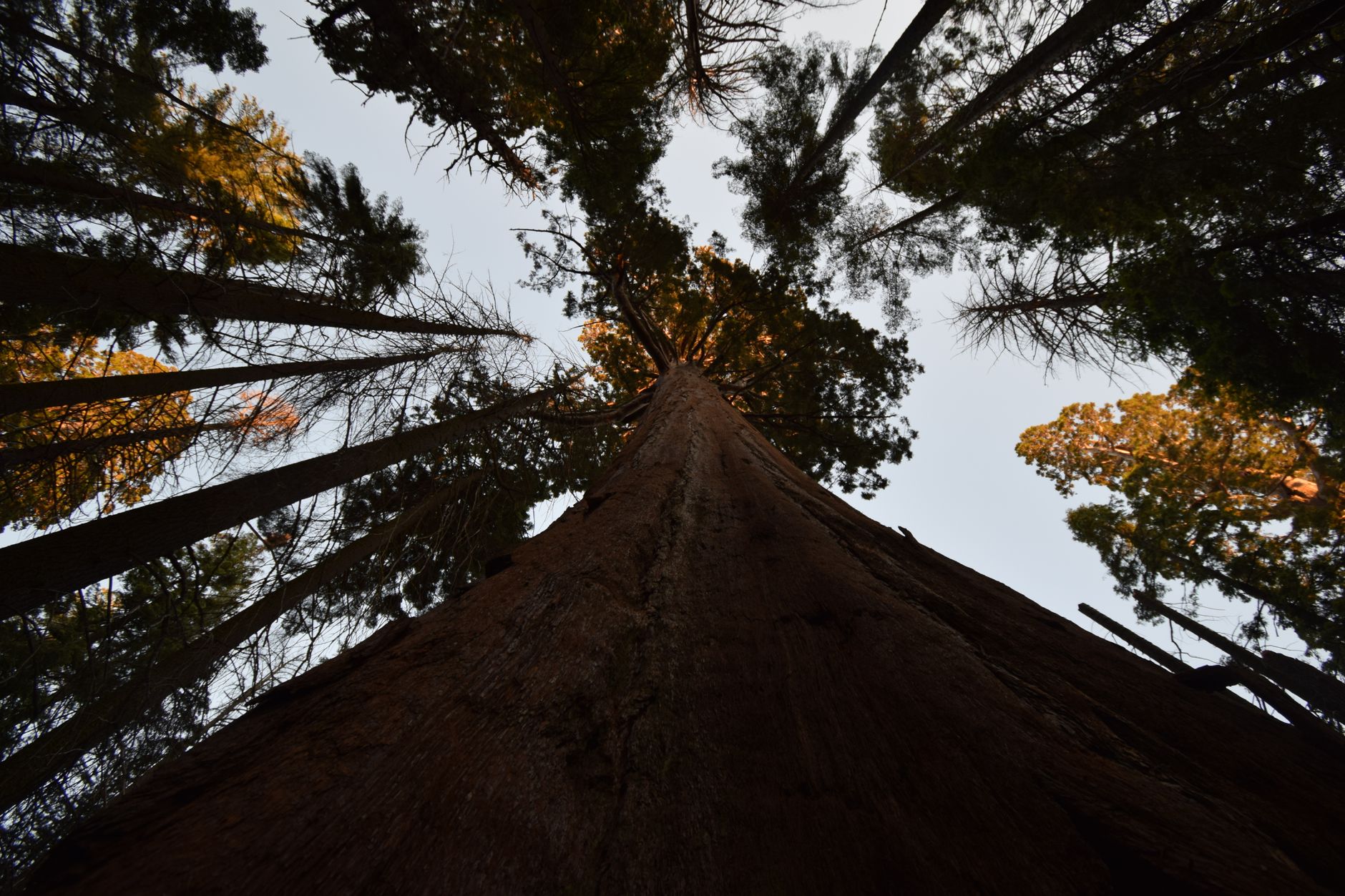
The statistics of sequoia size are well-known but poorly absorbed. The largest known living tree by volume is General Sherman in Sequoia National Park, measuring approximately 52,500 cubic feet of volume. That number is almost meaningless until you try to hold onto it while standing next to the tree. The base of General Sherman is wider than most rooms. The first major branch, roughly 130 feet up, is larger in diameter than most mature trees in an eastern forest.
What makes the scale harder to grasp is that sequoias don't taper dramatically the way most large conifers do. They remain extraordinarily thick through much of their height, which is why their volume figures so dominate the record books even though other trees — certain coast redwoods, some Australian eucalyptus — grow taller. The mass is distributed differently from anything intuition prepares you for.
The oldest known giant sequoias are estimated to be over 3,000 years old, with some dendrochronological studies placing certain individuals at approximately 3,200 years. A tree that was already a sapling when the Bronze Age was ending in the Mediterranean, that was a young but established tree during the founding of Rome, that was already ancient when European explorers reached the Americas — that continuity of living biology is genuinely difficult to hold in the mind. The tree has a biography longer than most civilizations.
Fire: The Paradox at the Heart of Sequoia Ecology
The relationship between giant sequoias and fire is one of ecology's more elegant demonstrations that a force we instinctively categorize as destructive can be essential for life. Sequoia cones can remain on the tree for 20 years or more without opening. They open most reliably in response to the heat of a passing fire, releasing seeds onto freshly cleared, ash-fertilized mineral soil — exactly the conditions sequoia seedlings need to establish, since they can't germinate in the thick duff of an unburned forest floor. Low- and moderate-intensity fires historically moved through sequoia groves roughly every 10 to 35 years, clearing competition, recycling nutrients, and triggering the regeneration cycle the species evolved to depend on.
Decades of aggressive fire suppression throughout the 20th century broke this cycle across most of the Sierra Nevada. Fuel loads accumulated on forest floors that would historically have burned regularly. The result was not a stable, protected forest — it was a forest that became catastrophically flammable, carrying fires far hotter and more extensive than the ecosystem evolved to handle.
A 2022 study found that high-severity wildfires — larger and hotter than historical fires — killed an estimated 10 to 20 percent of the entire global population of mature giant sequoias in two fire seasons between 2020 and 2021. That figure — a significant fraction of the entire global population of the world's largest trees, lost in two years — is the clearest possible statement of what happens when fire ecology is disrupted for long enough, and what climate-amplified fire seasons mean for a species with no backup range. The KNP Complex and Windy fires of 2021 burned through some of the most significant grove complexes in the Sierra, including parts of the Giant Forest area and groves in Kings Canyon. Some sequoias that were several thousand years old did not survive.
The irony is not lost on ecologists: the very fire that, at the right intensity, is necessary for sequoia regeneration has become, at the wrong intensity, one of the most immediate threats to sequoia survival.
What Climate Change Is Doing to the Ecological Band
The narrow elevational band that defines sequoia habitat is not fixed. It is defined by climate conditions — and those conditions are shifting. Warmer temperatures are reducing the duration and depth of snowpack at mid-elevations throughout the Sierra Nevada. The slow-melt moisture reservoir that keeps soils viable through the dry season is contracting. What this means for the long-term viability of sequoia habitat is not fully resolved scientifically, but the directional pressure is clear: the conditions that define the lower boundary of sequoia habitat are moving upslope. The problem is that above the upper boundary, conditions don't become more suitable — they become unsuitable in a different way.
The trees themselves, as individuals, are not going anywhere. A 2,000-year-old sequoia is not going to die because temperatures warm by two degrees. But its ability to regenerate — to establish seedlings that survive long enough to become the next generation of giants — depends on those soil moisture conditions being present at exactly the right time. The grandeur you see when you walk into a sequoia grove represents regeneration events that happened decades or centuries ago, under conditions that may not recur in the same way.
How to Visit More Meaningfully
The most-visited sequoia groves — Giant Forest in Sequoia National Park, Mariposa Grove in Yosemite, Grant Grove in Kings Canyon — are magnificent and absolutely worth seeing. But they are also managed heavily, with visitor infrastructure that can inadvertently insulate you from what you're actually looking at. The shuttle buses, paved paths, and crowds are understandable responses to visitation pressure, but they can make it easy to process the experience as scenery rather than as ecology.
A few habits change this. First, find a grove with fewer visitors. Redwood Mountain Grove in Kings Canyon, for example, is one of the largest sequoia groves by tree count in the world and receives a fraction of the foot traffic of more accessible sites. Getting there requires a dirt road and a real hike — which is most of the point. The remote mountain retreats near less-visited grove areas of the southern Sierra can also anchor a trip that builds in time to actually absorb what you're seeing rather than photograph it and move on.
Second, look at the young trees. In groves with active regeneration — particularly in areas where prescribed burns have been conducted in recent decades — you can find sequoias that are 50 or 100 years old, still visibly young by sequoia standards but already substantial. Tracing the full arc from seedling to sapling to young tree to mature giant calibrates your sense of what you're seeing in the ancient individuals.
Third, look at the bark. Mature sequoia bark is extraordinarily thick — commonly two feet or more — fibrous, spongy, and high in tannins. It is largely non-flammable and contains almost no pitch. When you understand that this bark evolved specifically as armor against the low-intensity fires the trees depended on, and then look at the fire scars at the base of older trees — scars that have been healing over for decades or centuries — you start to read the tree as a record of its own ecological relationship with fire rather than just as an object of scale.
The Fragility Beneath the Grandeur
Giant sequoias look indestructible. Their size, their bark, their evident ancientness all signal permanence in a way almost nothing else in the natural world does. That appearance is accurate for individual trees under the conditions they evolved in — healthy adults rarely die from wind, disease, or the fires they co-evolved with. But the species as a whole is in a position of genuine ecological vulnerability. Its range cannot expand. Its population of mature trees has just demonstrated that it can be reduced by a measurable fraction in a single bad fire season. The conditions that make seedling establishment possible are under pressure from multiple directions simultaneously.
None of this is an argument for despair — park managers, researchers, and conservation organizations are conducting prescribed burns, studying seedling establishment, and working to build grove resilience in ways that are genuinely meaningful. But it is an argument for holding the experience of visiting a sequoia grove in a more complex register than pure wonder. These trees are not relics of the past that have somehow survived into the present through sheer stubbornness. They are living members of a functioning — and currently stressed — ecological system, one that requires specific conditions to persist, and those conditions are not guaranteed.
That, more than any volume measurement or age estimate, is what transforms a visit from sightseeing into something worth carrying with you afterward.
Sources
Every factual claim in this article was independently verified against the following sources:
- General Sherman Tree - Wikipedia — en.wikipedia.org
- Sequoiadendron giganteum - Wikipedia — en.wikipedia.org
- Assessing giant sequoia mortality and regeneration following high severity wildfire | U.S. Geological Survey — usgs.gov